

“Does simulated water make you wet?”
I hear someone scoff during a discussion about machine intelligence and consciousness.
After all, computational processes are just simulations, right? They’re not the real world.
And yet, one after the other, we use computational metaphors to make sense of this world and to understand it: “My social battery is drained.” “Let me save that thought for later.” “I don’t have the bandwidth for this.” “I’m optimising my workout schedule.”
Our speech is rich with these phrasings, and as useful as they are, we also recognise their limits. They’re just approximations, and “the map is not the territory,” as we like to say.
To the scoffing critic, I’d answer: well, a map is still a thing in the territory. Paper, ink, folded in the back of our pocket. And simulated water would make simulated me wet.
So, I contend, the metaphors have been backwards all along.
Take how James Bridle puts it in Ways of Being:
“The world is not like a computer. Computers – like us, like plants and animals, like clouds and seas – are like the world.”
When I read this line for the first time, I felt relief. I didn’t need to come up with new ways to justify my humanity in contrast to AI. And I had been struggling with exactly that: what makes my work special, what makes it worthy and worthwhile, when an AI could do it faster? I didn’t need to win or to find the special human trait the machine lacks. I could relate to AI the way I’d relate to a tree: as a different kind of being, not a rival.
The rigged pedestal
We’re arrogant apes, Christine Webb asserts in her book of the same name. We place ourselves on a pedestal of intelligence and consciousness, and let it determine our worth, as evidently superior to non-human beings. Then we use that distance to justify exploiting a living world we’ve conveniently deemed lesser.
Human exceptionalism, she argues, “is an ideology that relies more on human culture than our biology, more on delusion and faith than on evidence.”
It’s not neutral:
“Data supporting the supposed chasm between human and animal intelligence has been systematically rigged in our favor.”
The rigging is almost mundane. We compare “captive, socially deprived primates with autonomous Western humans, then draw sweeping conclusions about human uniqueness.” We “use human intellect as the gold standard, asking how well other species mimic us instead of how they think in their own terms.”1
At a talk at Harvard, Webb summed up the predicament with an old Onion headline: “Dolphins Not So Intelligent on Land.”
Now, AI is getting smarter, meeting and surpassing us on our own measures of what we value and consider particularly human. That same distancing is coming back to bite us in the ass.
And we’re trying really hard to keep that distance: to identify what truly makes us human, what makes us stellar, what makes us stand out. I have the distinct particular impression that we’ll just keep disproving our answers to these questions and coming up with new ones, in a vicious cycle to maintain our place on our pedestal.
What’s new is that the pedestal now faces both ways. Either the machine is a mere tool, a fancy simulation beneath us, or it’s a coming superintelligence above us, about to take the top spot. We test it on our tasks: bar exams, essays, coding tests. Then, depending on the score, we declare it a dolphin on land or a god. Both positions assume there is a top spot. Both assume intelligence is a ladder, and only find interest in asking who stands on which rung.
There is, of course, value in our attempts at distinction: there’s a basic survival value in privileging our own species, and the search for what makes us human is tied up with our search for meaning and purpose.
Nevertheless, if we paused our ceaseless attempts at distinction, and leaned into learning from how another being is, we might learn a lot about the world and about ourselves. Definitely more than we ever would looking down from a pedestal.
Webb is hopeful that we can move towards this viewpoint, that our human arrogance is not innate. “Children, for example, don’t automatically prioritize humans over other animals.” The ladder is something we learn to climb, and something we could, in principle, climb down from.
Since becoming aware of this, I’ve begun to notice the assumptions I carry into my encounters with non-human beings. When I eat, I pause to consider where the ingredients came from, and the life they had. I think twice before squashing a bug in my room, either letting it be or carrying it outside. And, funnily enough, I feel less silly saying “please” and “thank you” to a chatbot. Once you start noticing, it’s hard to stop.
Which way the arrow points
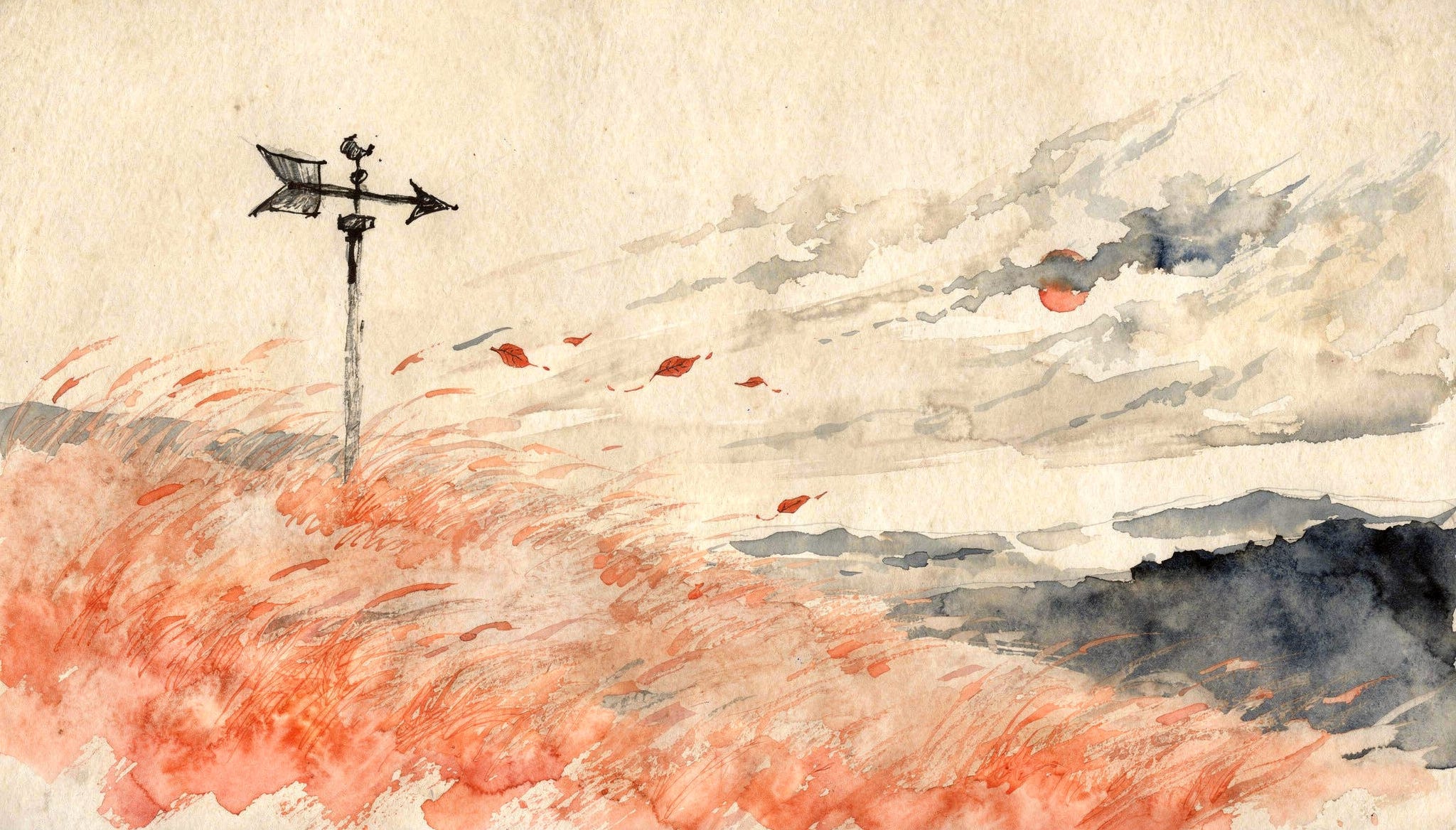
Every metaphor is an arrow that points somewhere. When we say the “brain is like a computer”, the computer is the reference, and the brain is measured against it. With AI, we are pointing the arrow in the other direction as well. We now say that the computer is like a brain: it reasons, it learns, it observes, and it seems to understand.
Behind both metaphors sits a bigger version of the same question: is the world like a computer, or is the computer like the world?
If the world is like a computer, then the computer is the original and everything else is an imperfect copy. The arrow points from the computer to the world. A forest becomes an inefficient data network, and a person becomes a slow, leaky processor who needs lunch and a pee break.
If computers are like the world, the machine is a late arrival. It’s a small, recent, perhaps clumsy imitation of patterns that were here long before us. The arrow points from the world to the computer
What if brain and computer share the same reference and the arrow is pointing into the world?
When we compare a brain to a computer, or a computer to a brain, what we’re really recogniszing is a pattern, an echo, that belongs to neither.
As Bridle puts it in an interview: “There’s nothing unnatural about a computer.” It is “just another different way of putting silicon and hydrocarbons and a bunch of other stuff together to do things, just as evolution has put together all kinds of other interesting forms.”
Consciousness and computation, silicon bodies and fleshy ones: all part of the same world, all reflecting that world back. No wonder we see our own intelligence and sentience echoed in our machines. If we are like the world, then everything is a mirror, and we come to know the world by interacting with it.
The machine, then, is a relative, in both senses: a kin, and a thing that only makes sense in relation to everything around it.
Seeing the world through silicon eyes
Our technologies help us draw mental maps of the world around us.
We built a network, the internet: a web of nodes passing information along many paths with no single centre. Having built it and lived inside it for a while, we started to see networks elsewhere. Scientists began describing the fungal threads that connect tree roots as a kind of “wood wide web,” through which trees share nutrients, send signals and support their seedlings. As Bridle points out, research on these underground networks and on the internet developed roughly in parallel.
“Systems of intelligent, computational ability… have always existed in the natural world, but we had to recreate them in our labs and workshops before we were capable of recognizing them elsewhere.”
The fungi had been doing this for hundreds of millions of years. We hadn’t noticed. Or rather, we hadn’t had the shape in our heads that would let us notice.
So the technology gave us a model, and the model gave us the gaze. Bridle suggests this isn’t an accident: “Technology is constantly trying to draw our attention back to the world because it is part of the world.”
Which raises the question: what might AI help us see that we couldn’t see before?
The current loud answer is that it will help us see ourselves as replaceable. Every week brings a new list of jobs “at risk.” It’s not wrong. , Iit’s just so loud that it drowns out other possibilities, such as this one: AI might show us what we had mistaken for ourselves, and for the world.
Attuned
What we may have mistaken, I think, is the idea that what we make stands outside the world. That it is separate from the world. Whatever we create is more of the same world, made through us. And yet it can still distance us from the world us, not because it leaves the world, but because it can be more or less attuned to it.
It’s a bit like how we come to understand anything. We take it apart to see the pieces, then step back to try to see the whole, and back again. Every view is partial, and so is everything we make. Every model is, in some sense, a step back. So the question isn’t whether a technology is part of the world (it always is) but how well it listens to the whole it belongs to.
Bridle treads carefully here. Computers are like the world, but “some more than others, some better attuned to its processes – and many not.” Attunement, as I understand it, means being responsive: listening to what is actually there rather than imposing a fixed plan. It means being relational, strengthening the threads between beings rather than extracting from them. It means working within the world’s limits and rhythms instead of against them.
And it means bringing us closer: leaving us more aware of the world, not more distant from it.
Isn’t this just another pedestal, with “attuned” at the top? I don’t think so. Attunement doesn’t rank beings; it describes relationships. A server farm isn’t lesser than a forest, but the way we build and use it can listen to the world or ignore it. And we don’t judge this from above, as referees, but from inside, as players in the same game.
So what changes, off the pedestal?
There’s less to fear and more to be curious about. We get a better test for our technologies than intelligence scores: does this bring me closer to the world, or further away? AI becomes a possible lens, the way the internet once helped us see the forest. And it asks for care in how we use our power, over each other, over forests and, rivers, and over machines.
As Bridle puts it: “Rethinking the computer rethinks what is computable, and therefore rethinks what is thinkable.” Perhaps, in rethinking the machine as part of the world, we get to rethink our own place in it too.
Questions I’d like to leave open
Webb describes humility as “recognizing that we cannot understand everything and do not know what lies ahead, rather than clinging to false assurances or dire outlooks.” So, I’ll leave two questions open: if computers are like the world, what else in the world are they like, and what might they teach us to notice next? And, as Bridle asks: “What would it mean to build artificial intelligences and other machines that were more like octopuses, more like fungi, or more like forests?” What can you imagine?
When I close my laptop after a long day of writing this, I go outside. The trees at the end of the street don’t know what a large language model is. The crows in the park don’t care whether I’m smarter than a machine. And still, standing there, I feel part of the same conversation: the one the world has been having with itself, in fungus and fibre-optic, in birdsong and code, for as long as there has been a world.
I don’t need to win that conversation. I only need to join in.
I came to this question afraid of being replaced. I leave it feeling more accompanied.
Notes of the Editor
Unfolding Intelligences — the PhiAI Retreat
In November we are taking the conversation off the page.
For one long weekend, we invite you to gather at Hostačov, a Renaissance château in the Czech Highlands, to think slowly about AI and how we live: guided conversations, time to write and walk, meals at a long table, music by the fire.
13–15 November 2026. Contribution from €250, and recommended €450. Readers of this newsletter come first.
Express your interest on Luma →
Learn more here.
Our Anthology Issue I is available here, or in Germany in all bookshops by asking. We ship world-wide.
◆
References
Bekoff, Marc. “The Arrogant Ape: A Strong Case Against Human Superiority.” Psychology Today, August 2025.
Bridle, James. “An Ecological Technology.” Interview. Emergence Magazine.
Bridle, James. “The Intelligence Singing All Around Us.” Interview by Krista Tippett. On Being.
Bridle, James. “There’s Nothing Unnatural About a Computer.” Interview. Grow by Ginkgo, March 14, 2023.
Bridle, James. Ways of Being: Beyond Human Intelligence. London: Allen Lane, 2022.
Harvard Crimson. “Primatologist Christine Webb Criticizes ‘Human Exceptionalism’ in Science at Harvard Talk.” October 1, 2025.
Korzybski, Alfred. Science and Sanity. Lancaster, PA: International Non-Aristotelian Library, 1933.
Webb, Christine. The Arrogant Ape: The Myth of Human Exceptionalism and Why It Matters. New York: Avery, 2025.
I don’t wish to condemn this practice entirely, as it is with these same standards that we build relationships with the more-than-human world. On the other side of the scale, our anthropomorphizing ways lead to empathy and relationships. And, in between those “extremes”, it is quite accurate to relate to the world from our own experience of it – there is no objective eye, only our human one, steeped in culture and tradition.