

Trent McConaghy dropped this line, inside a broader transhumanist pitch at Computational Consciousness1, the gathering the California Institute for Machine Consciousness (CIMC) held in Berlin last month. I was in the audience.
I sat there and looked around. Nobody blinked. A few heads nodded; a few mouths settled into a knowing half-smile.
I disagree.
I think we are closer to trees than to cyborgs. And the fact that the first sentence makes most of us smile while the second makes us squirm is the reason I wanted to write this piece.
How the argument goes
In that room in Berlin the argument in favor of cyborgs remained unspoken. (Could it be that in these circles it is so taken for granted that there is no need to explain?)
Nonetheless, the line and the following argument have a long pedigree. They echo the title of Andy Clark’s 2003 book Natural-Born Cyborgs2, which grew out of the “extended mind” thesis he developed with David Chalmers3: the idea that our thinking has always spilled over into the tools we think with. It deserves its strongest version, so here it is.
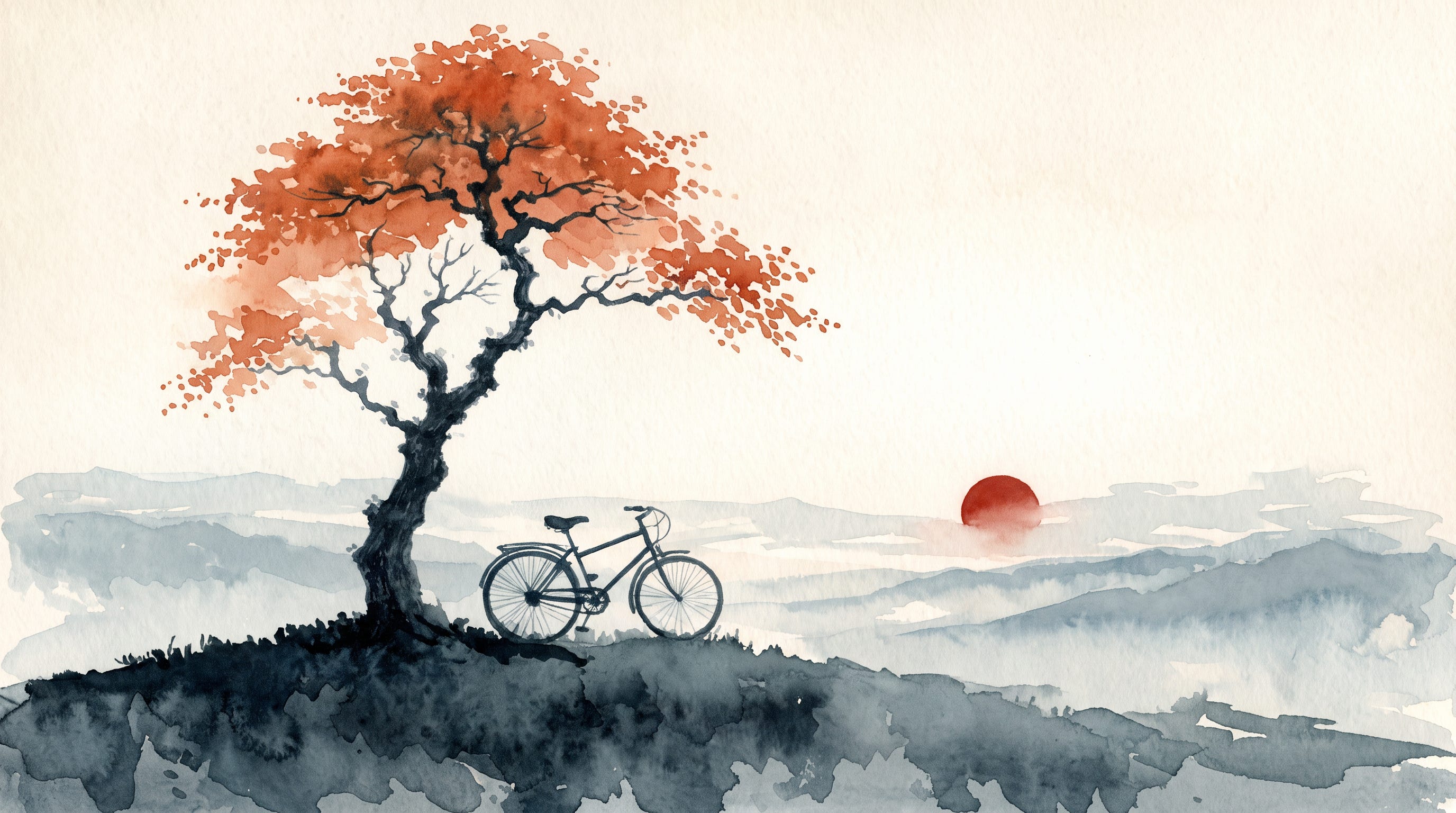
When we ride a bicycle, the bicycle becomes us.
Think of when you learned how to ride a bike. When you started, you were very aware of the pedals, the balance, and how firm you had to grip the handlebar. Once you became proficient, all this was abstracted away and you only had to think of where you go. In that sense, the bike becomes an extension of you. Quite similar to your legs. When you walk, you don’t think about what is needed to bend your knees, and the orthopaedic machine that makes it possible.
It is in this sense that one could argue that we are the bicycle.
The brain seems to agree. When we use a tool, it redraws the map of the body to include it. Maurice Merleau-Ponty described the blind man whose cane stops being an object and becomes the place where he feels the world4. Decades later, neuroscientists watched neurons in monkeys extend the body’s boundary to the tip of a rake5.
Similarly, when we use a keyboard to type, the keyboard becomes an extension of us, so we are the keyboard. If you keep increasing the degree of sophistication of the tool on the other side of the sentence, then you end up in mind-uploading and “we are cyborgs”-land. The argument is that merging with machines isn’t a break with human nature. On the contrary, merging with machines is its continuation.
I think under the hood this argument is trying to do something else. When I hear “we are all cyborgs” my reaction is: Wait. Why would I want that? A human experience in its quality of embodiment seems so much richer, that I wonder: who wants to become a cyborg, at all? Or the other way, given the choice between human and cyborg, who in their right mind would go for cyborg? (Convinced transhumanists may reverse the question, I know.)
The line answers that objection before anyone can raise it. You can’t refuse to become something you already are.
The talk ran one way. There was no time for questions. I said nothing.
We are all born trees
Some days later, in a very different setting, I was walking with Camila Lombana Díaz, an ethicist and a fellow writer in this collective. She was telling me about Muisca thought, the knowledge of the Indigenous people of the Colombian Andean highlands, and about her work translating it for a Western audience. At some point one of us said something like: we are water, we are trees.
I laughed, and then I stopped. Why did that sound stranger than the cyborg line?
This is remarkable considering that plants and animals are family. We shared a single lineage until roughly 1.5 billion years ago6. We store information in the same molecule, DNA, written in the same four-letter alphabet. Our cells are built on the same architecture, with a nucleus and mitochondria to power them. And we are made of the same few elements: carbon, hydrogen, oxygen, nitrogen.
I could keep listing the kinship, but the comparison interests me less than the reaction.
The tree sentence sounds strange precisely in the circles that are building and deploying technology today. Our way of living has made some of us feel more kin to a machine than to a forest.
What is the impact of that?
What the tools taught us
To answer that, we have to spend a moment in cyborg-land and ask what it tells us about where we begin and where we end.
Start with the bicycle again, and accept it. The extension is real. Still, using a tool is not becoming the tool. I can get off the bike. I can’t take off my legs when I’m done walking. When the bike gets a flat tire, I feel no pain on its behalf. I might be annoyed that I have to fix it, but nothing in me hurts. The fusion lasts only while the bike is in use; the moment I dismount, I look at it again as an object.
Martin Heidegger noticed this almost a century ago. A hammer in use is “ready-to-hand”7: it disappears into the work. Only when it breaks does it reappear as a thing in front of us. The flat tire is that moment. The bicycle steps out of me and back into the world.
Now look at what all these tools have in common. The bicycle, the keyboard, the cane: each one answers to us. It moves when we move and goes still when we leave. We command; it obeys. A life lived among obeying things teaches a particular model of the self: the self as the one who is obeyed, and amplified.
In that world, the question is what I can do with the tool that I couldn’t do without it. Notice that the focus is the action radius of the I.
What does that world leave out?
The we. The others. And the totality that holds us, or, if you want a less spiritual word for it, the substrate.
Yes, what about it?
We are not substrate independent
In transhumanist circles, “substrate independence” names the hope that a mind could run on any hardware, carbon or silicon. The phrase quietly assumes that what we stand on is interchangeable.
So excuse me for asking: Where does this cyborg live? What does it eat? Where does it shit? Who does it f*ck?
As much as modern life makes it easier to believe otherwise, we need to remember we are children of this Earth. We are not born in flasks, and we cannot live on synthetic formulas: even infant formula is made mostly from cow’s milk, and astronauts in orbit still eat food grown on the ground below them. Even above Earth, they eat Earth. We depend on air, on water, and on the relationships we make and keep.
Just as with the bike, we have abstracted away this relationship. We buy our groceries already made and we no longer fetch water from the river.
But the fact that the substrate has been made invisible doesn’t make it any less needed.
The orchid
Take the example of orchids. Their seeds are like dust and carry no food with them. In the wild, a seed can only germinate if the right fungus finds and feeds it, in a symbiotic relationship.
Then, in the 1920s, the botanist Lewis Knudson showed that the fungus could be skipped: sow the seeds on sterile agar with sugar and minerals, seal the flask, and they would sprout8.
It is a remarkable piece of technology. And look at what it does. The orchid is not freed from its dependency but it is identified and supplied: the medium, the sugar, the light, the humidity, the temperature. Technology can replace the fungus but not the need for one.
This is what the cyborg view forgets. There is no configuration of tools, however sophisticated, in which the ground stops mattering. The more we engineer, the more of that ground we have to provide ourselves.
And a farm of orchids, however well run, is not a forest. A forest is more than a collection of trees: it is the fungi beneath them, the water between them, the animals moving through them, and the relationships they build.
The ground
I think back to the room in Berlin, and to the line I didn’t react to. If I could reply to it now, I wouldn’t argue about cyborgs at all. I would ask about the ground.
The tools we build will keep answering to us; that is what tools are for. But what do they stand on? And who is supplying it?
In an orchid lab, the seedlings grow in rows of sealed glass flasks. Each one, no bigger than a grain of rice, sits on a bed someone mixed by hand: sugar, minerals, agar, light set to the hour. It is the most engineered version of an orchid there is.
And it still needs its ground supplied.
Notes of the editor
Unfolding Intelligences — the PhiAI Retreat
In November we are taking the conversation off the page.
For one long weekend, twenty-five of us will gather at Hostačov, a Renaissance château in the Czech Highlands, to think slowly about AI and how we live: guided conversations, time to write and walk, meals at a long table, music by the fire.
13–15 November 2026. Contribution from €250, and recommended €450. Readers of this newsletter come first.
Our Anthology Issue I is available here, or in Germany in all bookshops by asking.
References
Andy Clark, Natural-Born Cyborgs: Minds, Technologies, and the Future of Human Intelligence. Oxford University Press, 2003.
Andy Clark & David Chalmers, “The Extended Mind”, Analysis 58(1), 1998, pp. 7–19.
Maurice Merleau-Ponty, Phenomenology of Perception (1945), trans. Colin Smith. Routledge, 1962. Part One, “The Spatiality of One’s Own Body and Motility.”
Angelo Maravita & Atsushi Iriki, “Tools for the body (schema)”, Trends in Cognitive Sciences 8(2), 2004, pp. 79–86.
American Society of Plant Biologists, “From LUCA to Lily: 12 perspectives for teaching about plants”, Plantae.
Martin Heidegger, Being and Time (1927), trans. John Macquarrie & Edward Robinson. Harper & Row, 1962. §§15–16.
Lewis Knudson, “Nonsymbiotic Germination of Orchid Seeds”, Botanical Gazette 73(1), 1922, pp. 1–25.